





Is the underdog ready to unseat the No. 1? Here’s how Anisimova can take down Sabalenka
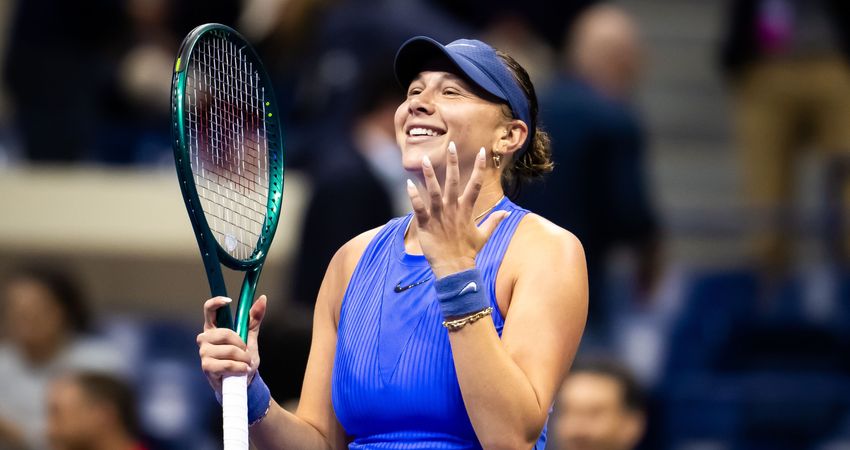
In the charged setting of a Grand Slam semifinal, belief can give you wings.
That unshakeable resolve and resilience has lifted Aryna Sabalenka and Amanda Anisimova into the final of this US Open. On Saturday afternoon (4 p.m. ET), one of them will emerge as champion.
In Thursday night’s rollicking semifinals, Sabalenka came back to defeat Jessica Pegula 4-6, 6-3, 6-4 and later Anisimova won a 6-7 (4), 7-6 (3), 6-3 thriller over Naomi Osaka.
Sabalenka is the World No. 1 and the defending champion, but Anisimova, with a 6-3 head-to-head advantage, has had the historic upper hand. They met nearly two months ago in the Wimbledon semifinals and Anisimova came out with a three-set victory.
Belief, Sabalenka said, was the difference.
“I felt like in that match at Wimby, I was doubting a lot my decisions,” Sabalenka told reporters. “That was the main thing that was bringing a lot of unforced errors.
Sabalenka 🆚 Anisimova US Open final is on! 🏆
— wta (@WTA) September 5, 2025
Saturday can't come soon enough 🙌#USOpen pic.twitter.com/GR5pXXRnsP
“I feel like I had my opportunities. I didn’t use them, and I feel like the key for me is going to be just go out there, obviously fight, but trust my decisions and go after my shots.”
That win, which delivered Anisimova to the final, is the one among six she cherishes most.
“We’ve had very, very tough matches,” Anisimova said. “I think the standout one was probably Wimbledon. It was really a seesaw match, which is almost always the case when I play her.”
Once more, with feeling, they’ll go at it again. We make the case for each:
Advantage, Sabalenka
Playing like the defending champion she is, Sabalenka was simply better in a rematch of last year’s US Open final, more powerful in the big moments than Pegula, beating her for the eighth time in 10 matches.
Sabalenka hit 43 winners, against 16 unforced errors, a plus-10 margin, compared to plus-six for Pegula. She had eight aces and, critically, saved five of seven break points.
BACK-TO-BACK-TO BACK US OPEN FINALS! 🤩@SabalenkaA will defend her women's singles title on Saturday! 🏆#USOpen pic.twitter.com/tXoFaIfdwa
— wta (@WTA) September 5, 2025
“She came up with some ridiculous shots on breakpoint,” Pegula said later. “I didn’t feel like I did much wrong.”
There are a number of reasons to view her as the favorite, but the underlying theme is that she’s been here and done that. Consider these numbers:
- This is Sabalenka’s seventh Grand Slam final, second only to Venus Williams among active players.
- It’s Sabalenka’s third consecutive US Open final, matching only Venus and Serena Williams this century.
- Sabalenka is the first woman to reach three Grand Slam singles finals in a season since Serena and Angelique Kerber (2016).
Perhaps the biggest factor here is motivation. Sabalenka’s already guaranteed of leaving with the No. 1 spot in the PIF WTA Rankings, but … After losing major finals earlier this year at the Australian Open and Roland Garros, Sabalenka is determined to finally collect a major title.
“It’s going to feel amazing,” Sabalenka told reporters. “I’m super excited to give myself another opportunity, another final. If I’ll be able to hold that trophy, it’s going to mean a lot for me. I’ll be just the happiest person on earth probably.”
She is now 99-26 in Grand Slam singles events, a winning percentage of .792, second only to Iga Swiatek among active Hologic WTA Tour players.
Achieving the century mark, in this ultimate match of the Grand Slam season, would be a crowning achievement.
Advantage, Anisimova
It’s been a breakout year for Anisimova.
And while getting to that Wimbledon final was at the time a career-defining moment, what she’s done in her past two matches was more impressive.
After losing to Swiatek 6-0, 6-0, she came back seven weeks later with a stunning 6-4, 6-3 victory. Lost in the wake of Anisimova’s comeback win over Osaka was this telling nugget: It ended a three-year, eight-match losing streak after losing the first set of a Grand Slam.
“LET’S GOOO!” 🗣️
— wta (@WTA) September 5, 2025
Look what it means to @AnisimovaAmanda🥹#USOpen pic.twitter.com/3TNbaTiZjp
“I could have easily said, ‘Oh, she’s playing better than me, and I can’t really do anything,’” Anisimova said of the Osaka match. “I have really worked on myself to really be able to handle those moments. I think I have really done a better job of that, and especially since the Wimbledon final.
“I think I have really shifted with my attitude.”
Second serves are a green light for aggression, and no one is jumping on them like Anisimova. Against Osaka, she won 28 of 42 return points on seconds -- and six of them were winners.
“I’m trying to be aggressive,” Anisimova said. “That’s always been a strength of mine.”
It will have to be a strength against Sabalenka.
Anisimova is the fifth American woman this century to advance to back-to-back Grand Slam finals, after Lindsay Davenport, Venus Williams, Jennifer Capriati and Serena Williams. She’s intent on following Madison Keys and Coco Gauff as a major champion this year.
“Obviously I’m excited, but I’m kind of shutting off all the noise around me and deleting everything from my phone and to just really focus,” Anisimova said. “Yeah, like, zone in on my opportunity and do everything that I can to be ready.”